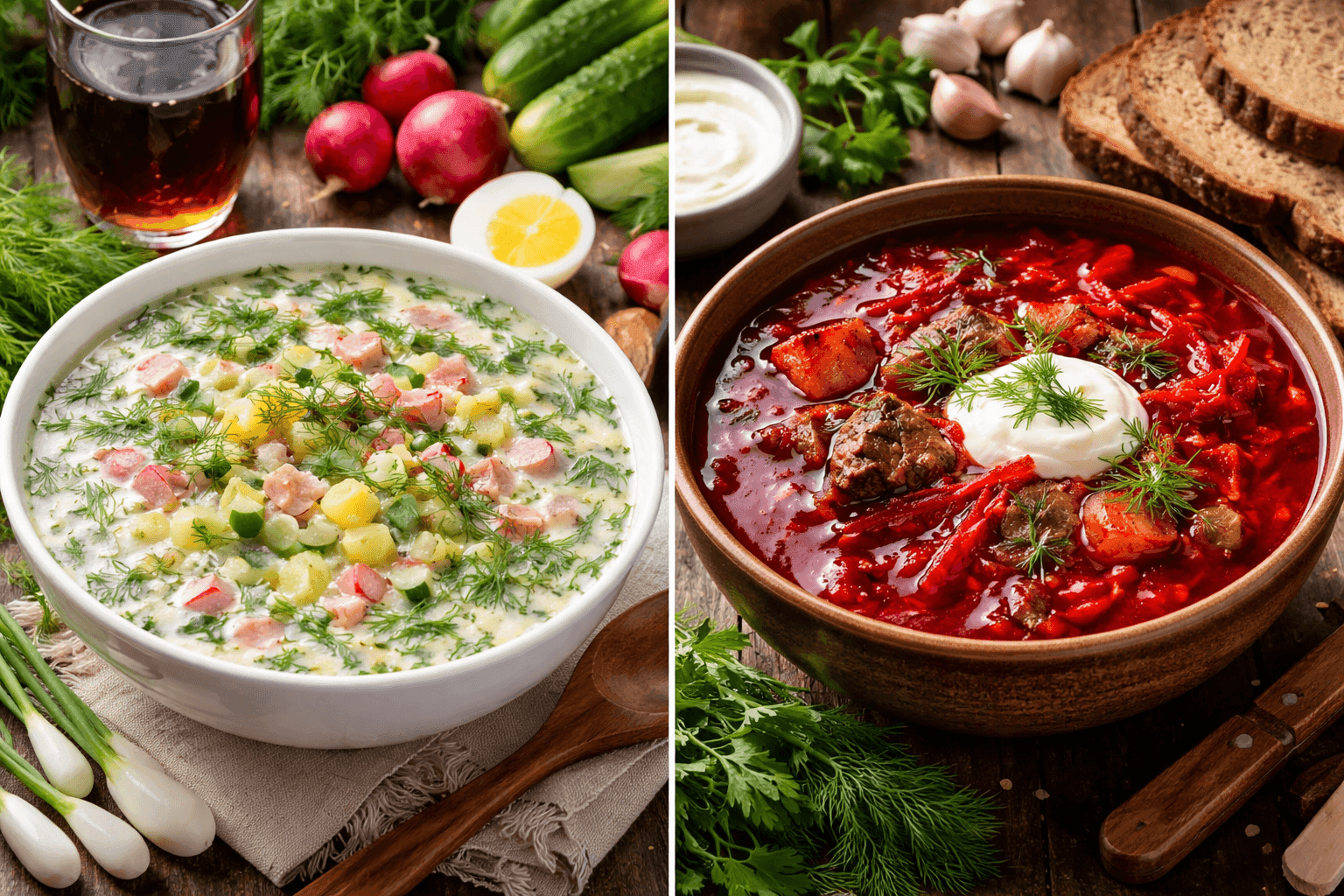
Today, I talked with a friend back in Russia, and she said, “It’s past mid-April, and it’s still so chilly. It made me want a bowl of borscht, so I made one.” I replied, “Well, I made okroshka the other day.” That was all my friend needed to picture the weather where I'm staying.
Борщ (mind you, there is no “t” sound at the end) is a hot soup made with beets, usually simmered in a rich beef broth with garlic, cabbage, potatoes, and a mix of sweet and sometimes hot peppers. Borsch is believed to originate from Ukraine but is also very popular in all parts of Russia. Hearty and deeply warming, it’s the kind of soup that feels made for long, cold days.
Oкро́шка is, in many ways, the opposite — you don’t make a broth, and you don’t cook the ingredients together. In my view, because of that it’s not really a “soup” at all — it’s simply окро́шка, a thing unto itself. It’s made with chopped boiled potatoes and eggs, fresh radishes, cucumbers, dill, and green onions, all brought together with either kefir or kvas. And this is where a true Russian holy war begins: квас или кефи́р ? I’ll sit this one out — you can find plenty of recipes online and try both versions (but my strong advice is to do it in summer).
Some people joke that okroshka is the Russian for "oh, baby" because "кро́шка" (literally, "a breadcrumb") also means "little one". In fact, the name of the dish comes from the verb кроши́ть - to crumble or to chop into small pieces.
Both borscht and okroshka tell the same story: how people shape food to fit climate, memory, and mood. One warms you from the inside on a bleak April day; the other cools and brightens a steamy southern afternoon. Talking about them with my friend felt like passing a weather report in soup form — a reminder that language and taste carry home across any distance.
You can also bring a little of that home with you — explore songs, short stories, poems, and language posts on our Russian site.