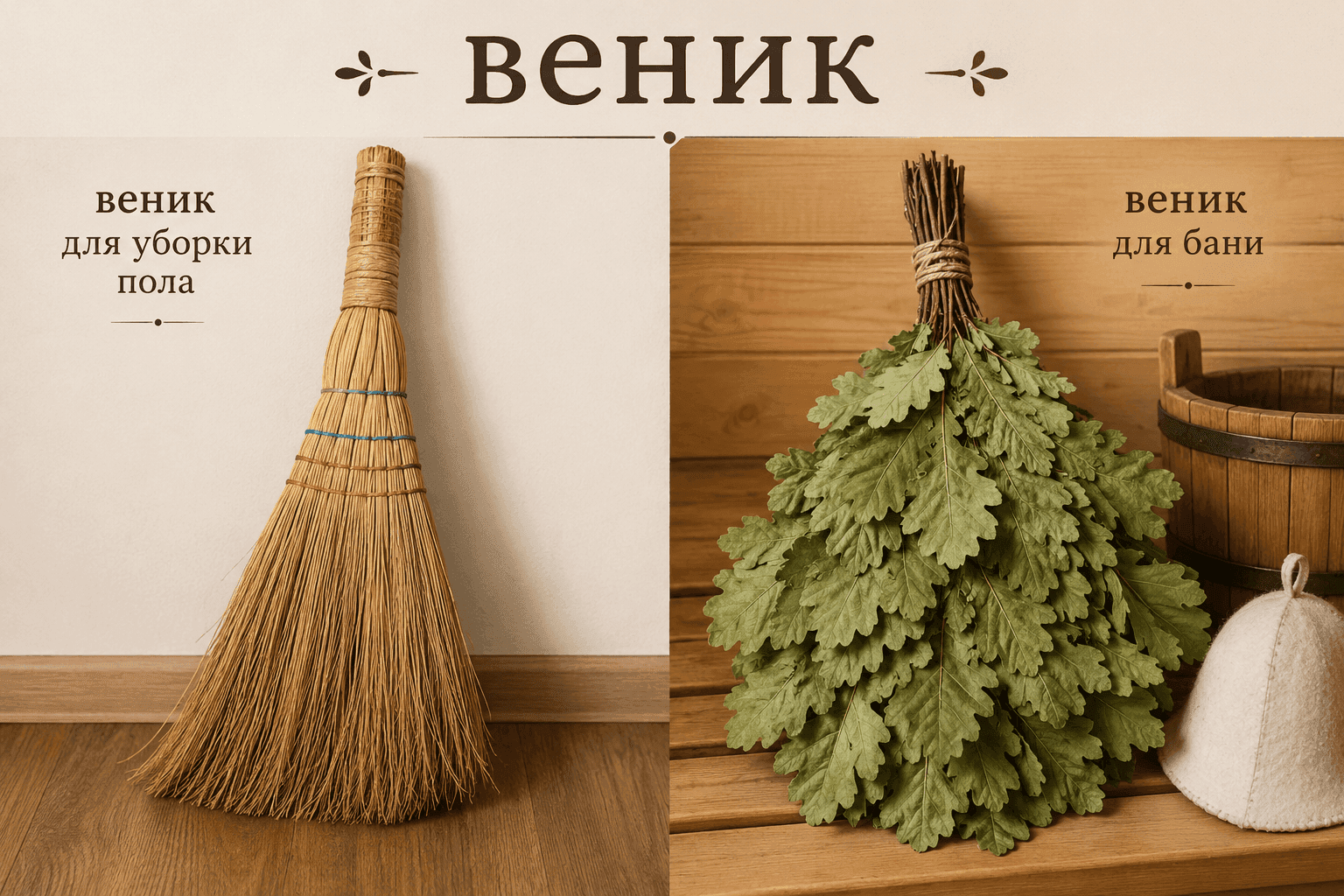
Even in our age of voice-controlled robot vacuum cleaners, many homes in Russia still keep a very traditional cleaning tool — the humble ве́ник. It is a short-handled broom, simple in design, but still widely used in everyday life.
The most familiar type of ве́ник is made from broomcorn (a type of sorghum with stiff, straight stalks). Tied tightly together, these stalks form a light, practical broom that remains common in rural homes and at dachas. Simple? Yes! We even have the expression «просто́й, как ве́ник», used to describe a person who is straightforward and unpretentious.
However, a different type of ве́ник can participate in a more sophisticated Russian ritual when it’s used in the ба́ня (steam sauna). There people use a bundle of leafy branches — most often birch, but also oak, eucalyptus, or fir. In the heat of the steam room, the branches are tapped or brushed against the skin, helping to stimulate circulation while releasing a distinctive, natural aroma.
Beyond its simplicity, the ве́ник also appears in Russian storytelling as a metaphor for unity. Leo Tolstoy wrote this short fable for children:
There once lived an old man who had three sons. The brothers often quarrelled with one another.
The old man worried: “When I die, my sons will split apart and go their separate ways, and then all of them will suffer.”
The time came when the old man was about to die. He called his sons and told them to bring him a broom (venik). The sons brought it.
The old man said: “Break the venik.”
The sons replied: “How can anyone break a venik?”
Then the old man untied the bundle, and the sticks fell apart. “Now break the sticks,” he said.
The sons broke them easily.
The old man then said: “It will be the same with you as with this broom. If you live together in harmony, no misfortune will overcome you; but if you go your separate ways one by one, anyone will easily ruin you, just as the single twigs were easily broken.”
If you liked this one, you can find more stories from the famous author’s Russian Reader in our Kindle book Five Short Stories by Leo Tolstoy along with exercises and answer keys for self-study.
Stay clean, healthy and strong and come back to enjoy our new posts on Choot-Choot-Russian!