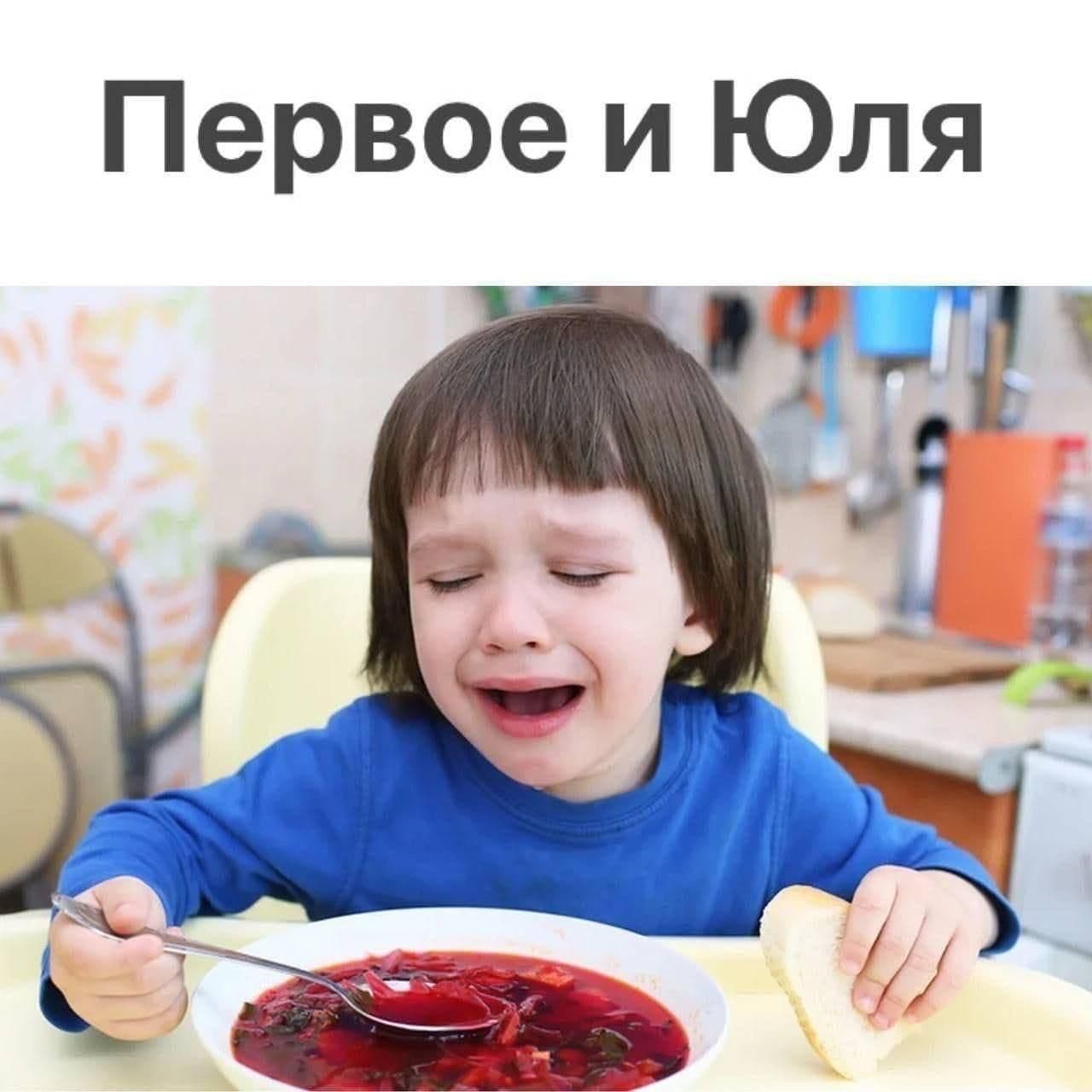
Today is the 1st of July, and a friend of mine shared this meme based on a homophone - "первое июля" VS "первое и Юля". What's up with little Yulia? Does she dislike her soup? What about you? Is soup part of your country's culinary tradition?
Well, how about talking a bit about eating traditions in Russia and learning a few new words?
Little Yulia is crying over her пе́рвое. Grammatically, it's a neuter adjective that stands for the phrase пе́рвое блю́до - the first course, which is usually soup. It's considered to be healthy, but children often don't like it. I wonder why! As you can easily guess, the second (main) course is called второ́е. It usually consists of meat or fish with some garnish, and we sometimes refer to it as горя́чее (the hot dish). In a restaurant you'd be also offered a dessert, but if you eat at home, you will likely finish your lunch with a drink - tea or coffee. Homemade компо́т is a must for children!
All that was about обе́д, which, unlike lunch in English, is not tied to a particular time but is the biggest meal of the day.
Food Vocabulary
I promise I'm not trying to make you feel hungry - let's devour interesting facts about food-related vocabulary! What other meals do we have in Russia?
За́втрак starts the day. It sounds so similar to за́втра that you might wonder why you have tomorrow's meal this morning. In fact, за́втрак comes from the old Russian зау́трок - the morning food.
По́лдник - even though the word is derived from по́лдень, it is a light snack between обе́д and у́жин, usually between 4 and 5 pm. I'm not pulling your leg! :) There are two possible explanations. One suggests that this meal actually used to be at noon, but as people's lifestyles changed over the centuries, they started to have this snack in the afternoon instead, while keeping the same word for it. Another popular idea is that for the farmers in the past, 4pm was the middle of their work day.
У́жин is the last meal of the day. Russian-English dictionaries often translate this word as supper, but I don't think it's very common nowadays, not in the US anyway.
Russian Wisdom
In conclusion, I want to share a piece of wisdom from the famous 1700s Russian general Alexander Suvorov:
За́втрак съешь сам, обе́д раздели́ с дру́гом, а у́жин отда́й врагу́.
Eat breakfast yourself, share lunch with a friend, and give dinner to your enemy.
What do you think it means? Do you agree? Share your ideas in the comments!